
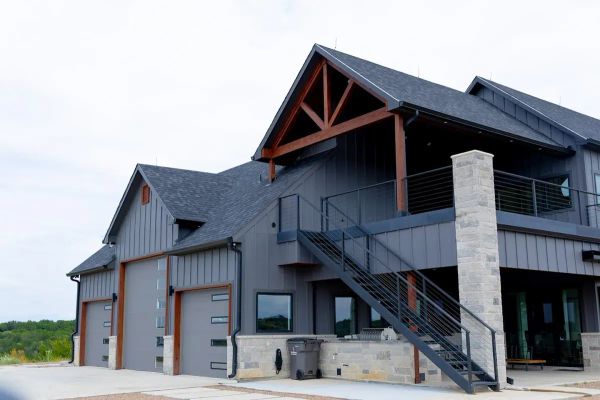
Most of the land that makes people fall in love with Springtown is raw: five to twenty acres off SH 199 or FM 730, big sky, no neighbors, and no infrastructure whatsoever. I have been building on exactly this kind of Parker County land since 1995, and the honest rule is this: on raw acreage, the land has to become buildable before the house can start. Water, waste, power, access, and a pad. Get those five right and the build itself goes smoothly. This post is the playbook we run on every custom home on acreage, with real cost ranges stated the honest way, as ranges.
What Does It Take to Build on Acreage in Springtown?
Five infrastructure items, in roughly this order: a water source (private well or a rural co-op tap), an on-site septic system permitted through the county, an electric service run from the provider's nearest point, a driveway with proper culverts, and an engineered building pad. On truly raw land, the combined site budget routinely reaches six figures before the slab is poured. That is not a reason to avoid acreage. It is a reason to budget the land and the site work together, which is exactly why a cheap tract is not always the cheap option. If you have not closed on land yet, read my checklist on what to verify before buying Parker County land first.
How Deep Is a Water Well Around Springtown, and What Does It Cost?
Most acreage around Springtown, Reno, and the Wise County line draws from the Trinity aquifer group, and depth varies meaningfully from one tract to the next. Wells in this area commonly run a few hundred feet, with some sites needing to go considerably deeper to find reliable production. The Texas Water Development Board maintains groundwater data and well reports that show what drillers have actually hit near your parcel, and we pull nearby well logs before anyone commits to a number.
On cost, I will give it to you the way I give it to clients: as a range, because depth, casing, and pump size drive it. Complete well systems on our recent acreage projects, drilling, casing, pump, pressure tank, and wellhouse or cover, have typically landed in the $20,000 to $50,000 neighborhood, with shallow, easy sites under that and deep or low-producing sites above it. Anyone who quotes you a single flat number before drilling is guessing. Budget the range, then let the driller's log settle the invoice.
Two practical notes. First, test what nearby wells produce before you buy the land, because a weak well changes your landscape plans and can change your appraisal. Second, drill before you finalize the septic layout, since the well and the septic field need proper separation and the two systems fight for the same good ground on smaller tracts.
Do You Need a Conventional or an Aerobic Septic System?
The soil decides, not you. A licensed site evaluator tests the soil where the drain field would go, and that evaluation, submitted with your county permit, determines which systems your land can support. Deep, well-draining soils can take a conventional system. The tighter clays common across northern Parker County frequently push projects to an aerobic treatment unit with spray distribution.
| Conventional septic | Aerobic system | |
|---|---|---|
| How it works | Tank plus gravel or chamber drain field, gravity does the work | Aerated treatment tank, then spray or drip distribution |
| Soil it needs | Well-draining soil with real depth | Works in the clay soils common around Springtown |
| Typical installed cost on our projects | Roughly $10,000 to $20,000 | Roughly $15,000 to $35,000 |
| Ongoing obligations | Periodic pumping | Electricity, periodic inspections, and a maintenance arrangement |
| Footprint | Large drain field area | Spray area with required setbacks |
Both are permitted through Parker County for tracts on the Parker side, and the state rules for on-site sewage facilities come from the Texas Commission on Environmental Quality. Plan on the aerobic outcome in your early budget. If the soil evaluation comes back better than expected, you get money back in the plan, which is the direction surprises should run.
How Do You Get Electricity to a Rural Homesite?
The electric cooperative or provider serving your area will run service from their nearest point to your meter, and the operative word is nearest. If the line is at your road frontage, this is a modest line item. If your homesite sits a quarter mile back in the trees, you are paying for that run, and underground service, which most of our clients want for storm resilience and looks, costs more per foot than overhead. On long drives the service run can quietly become one of the larger site lines, which is one more reason home placement is a budget decision, not just a view decision. We get the provider's estimate early, while the site plan can still move.
While the trench is open, think ahead: conduit for a gate operator, the shop, and future fiber costs almost nothing during construction and real money afterward.
What About the Driveway, Culverts, and the Building Pad?
The driveway is infrastructure, not landscaping. County road departments require a properly sized culvert where your drive meets the road, and a drive that will carry concrete trucks, lumber deliveries, and a crane needs base material and grading done right at the start, not repaired at the end. On long entries we build the construction drive on the permanent alignment so the money spent during the build becomes the base of your finished drive.
The pad is where thirty years of Parker County dirt experience earns its keep. We cut, fill, and compact to an engineered plan, build in positive drainage away from the home on every side, and set the pad elevation with storm runoff in mind. On sloped tracts this is also where we decide whether the grade is an obstacle or an opportunity: some Springtown-area sites have exactly the fall you want for a walkout basement, which turns a site challenge into the best square footage in the house.
Who Actually Permits All of This?
Most Springtown-area acreage is unincorporated Parker County, so there is no city building permit out here. The septic system is the big regulated item, permitted and inspected through the county, with the state's TCEQ rules underneath. Driveway culverts involve the county road office. Wells must be drilled by a licensed driller to state standards. Tracts inside Springtown city limits, or north across the Wise County line toward Decatur, answer to a different office, and lake-side parcels down toward Azle can add their own wrinkles. We have worked with all of these offices for decades and handle the filings as part of the job, and this county-versus-city picture is one of the practical differences between building out here and building in town.
What Should You Do Next?
- If you are still shopping for land, involve me before you close. A free site walk tells you what the well, septic, power, and drive will roughly cost on that specific tract, which is exactly the number the listing does not include. Call me directly at (817) 736-6323.
- If you already own your acreage, start with feasibility. We will pull nearby well data, order the septic site evaluation, and get the electric provider's estimate so your budget is built on facts. Schedule a free consultation to get it moving.
- Budget the whole property, not just the house. The site work, the home, the shop, and the entry all come out of one number, and planning them together is how the number stays honest.
Raw land is the best canvas there is, and Springtown still has more of it than almost anywhere this close to Fort Worth. The families who enjoy it most are the ones who treated the infrastructure as part of the project from day one. That is how we have built out here for thirty years.