
Yes. You can build a basement in Texas, a real one, full height, finished, and dry. I know because I have been building real Texas basements in Parker County for three decades, and the ones we poured in the late 1990s are still dry today. That is the only metric that matters.
So why does nearly every builder in North Texas tell you no? That answer is more interesting, and it is worth understanding before you talk to anyone about putting a basement under your custom home.
Can You Really Build a Basement in Texas?
You can, and people do, just not many of them. There is no law of physics or line of building code that forbids basements here. What exists instead is a set of genuinely hard site conditions: expansive clay soil that swells and shrinks with moisture, a water table that sits high across much of Parker County, and a local trade base that has almost no basement experience because nobody asks them to build one.
Those conditions do not make a basement impossible. They make a careless basement a disaster. A basement built here the way builders pour them in Kansas or Ohio will crack, leak, and heave, and the builder will spend years in warranty fights. Most builders look at that risk and walk away. I looked at it and saw an engineering problem with a known solution, because I had already built basements in ground that fights back.
Why Do Most Texas Builders Say No to Basements?
When a builder in Weatherford or Aledo tells you basements cannot be done in Texas, one of four things is usually true:
- They are thinking of expansive clay. Much of North Texas sits on clay soils that absorb water, swell, then shrink hard in a dry August. That movement destroys rigid structures that were not engineered for it. You can look up the soil profile on any tract yourself through the USDA Web Soil Survey, and I recommend every land buyer do exactly that before closing.
- They are thinking of the water table. Parts of Parker County carry water surprisingly close to the surface. Dig a ten-foot hole in the wrong spot with no drainage plan and it becomes a swimming pool.
- Their trades have never done one. Basement excavation, forming tall walls, installing exterior membranes, and building perimeter drainage are specialized work. A framer who has spent twenty years on slab-on-grade homes has never had a reason to learn it, and a builder is only as good as his crews.
- Their lawyer said no. A leaking basement is an expensive callback. For a builder juggling fifteen houses at once, the liability math says skip it. For an owner-operated builder doing a few homes a year with his name on every one, the math says do it right instead.
Notice that none of those four reasons is "it cannot be done." Every one of them is "it cannot be done casually."
What Do Builders Tell You Versus What Is Actually True?
I have heard every version of the basement brush-off over thirty years. Here is how the common lines stack up against reality:
| What most builders tell you | The reality |
|---|---|
| "You can't build basements in Texas soil." | You can. The soil demands engineering, not avoidance. Soils reports tell us exactly what we are working with before we design. |
| "The water table makes it impossible." | The water table makes drainage mandatory. Perimeter drains, sump systems, and site grading handle water that careless builds ignore. |
| "It'll leak eventually. They all do." | Basements leak when waterproofing is an afterthought. With membranes and drainage designed as a system, ours from the 1990s are still dry. |
| "It's not worth the money here." | A finished basement is the cheapest finished square footage in the house compared to adding a second story of the same size, and it is rare enough in DFW to command real resale attention. |
| "Nobody around here does them." | Almost nobody does. That is a statement about the market, not about feasibility. It is also exactly why the ones that exist stand out. |
What Does It Take to Build a Texas Basement Correctly?
Four things separate a dry Texas basement from a future insurance claim, and none of them are optional:
A real geotechnical investigation. Before anything is designed, we drill the lot and get a soils report. The engineer needs to know the clay content, the moisture profile, and where the water sits through the seasons. On some lots the report says a basement pencils out beautifully. On a few it says walk away, and we listen.
Structural engineering for soil that moves. The walls, footings, and slab are designed for the lateral pressure expansive clay exerts when it swells. This is not a standard detail pulled off a shelf. Our structural engineers have been designing for Parker County ground with us for years.
Excavation and drainage as a system. The hole is cut oversized, perimeter drains are set at the footing, and the backfill is selected material, not whatever came out of the hole. Water that reaches the wall is collected and moved away before it can build pressure.
Waterproofing membranes, not dampproofing spray. The exterior walls get true waterproofing membranes, protected during backfill, lapped and sealed as a continuous barrier. This is the single most common place cheap basements fail, because spray-on dampproofing looks similar and costs a fraction as much.
Every one of those steps is inspected, documented, and covered under our written ten-year structural warranty. If a builder proposes a basement without walking you through all four, keep interviewing.
How Did a Colorado Builder End Up Pouring Basements in Parker County?
I learned basement construction in Colorado, where basements are standard and the ground is anything but easy. Colorado builders deal with expansive soils too, along with frost depth and groundwater, so the trade knowledge there is deep: how to drain a foundation, how to detail a membrane, how to backfill so the wall is protected instead of pressured.
When I started building in North Texas in 1995, I brought that knowledge with me and adapted it to Parker County clay. The soil chemistry is different, the water behaves differently, and the details evolved over three decades of local builds. What did not change is the underlying discipline: respect the water, respect the soil movement, and never let a schedule shortcut touch the waterproofing. That is the approach behind every basement in our gallery, and it is why we are one of the only builders in North Texas doing real, code-correct basements at all.
What Do Families Actually Use Texas Basements For?
The basements we finish are not storage caves. They are finished to the same standard as the main floor, and clients use them hard:
- Home theaters. Below grade is naturally dark and quiet, the two things a theater room wants most.
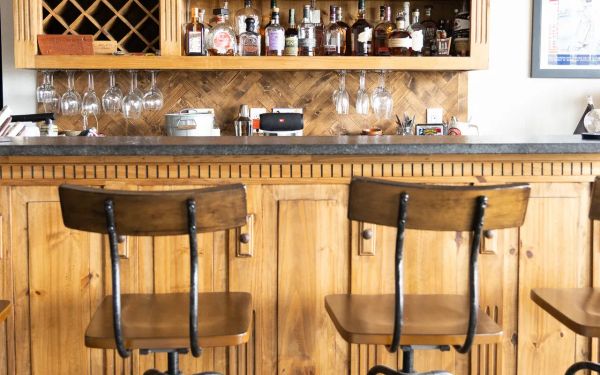
- Climate-controlled wine cellars. The ground keeps temperatures stable, which cuts the mechanical load of a serious cellar.
- Storm shelters that earn their keep year-round. North Texas sits in an active severe weather corridor, and the National Weather Service is blunt that a basement is one of the safest places in a home during a tornado. Our clients get that security wrapped inside space they use every single day, not a concrete box in the garage floor.
- In-law suites and guest quarters. A bedroom, bath, and living area below grade gives visiting parents real privacy, and on walkout lots it lives like a garden-level apartment.
- Gyms, game rooms, and kid zones. Square footage that absorbs noise and clutter without touching the main living areas.
Typical finished basement scope for us runs 800 to 4,000 square feet. On acreage builds out toward Springtown and Brock, where lots often carry slope, walkout designs open the lower level to daylight and the land.
If you are wondering what all of this costs, I wrote a full companion piece on what a basement costs in North Texas, including how it compares to adding a second story.
What Should You Do Next?
If a basement is on your wish list, do these three things in order:
- Talk to a builder who has actually poured them here before you buy land. Not every lot supports a basement, and the soils report decides. I will walk a tract with you before you close and give you an honest read at no charge through our build-on-your-lot process.
- Ask any builder you interview for addresses. Ask how many basements they have built in Parker County and how old the oldest one is. The answer tells you everything.
- Call me directly. I am glad to talk through your lot, your plans, and whether a basement makes sense for how your family lives. Schedule a free consultation or reach me at (817) 736-6323.
Basements are not a gimmick for us. They are a thirty-year specialty, and the reason clients drive past a hundred slab-on-grade builders to find us.