
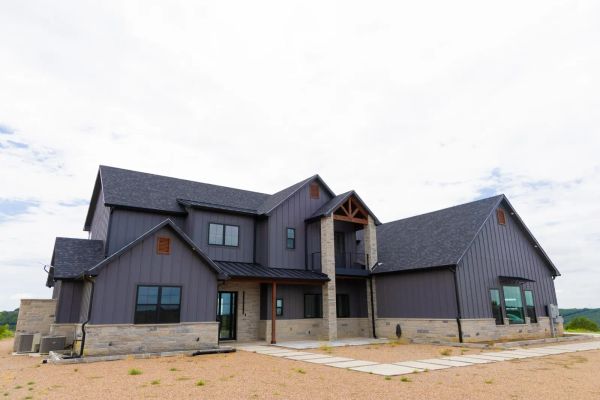
A barndominium can genuinely cost less to build than a custom luxury home, but only if you compare the right things. I have built both across Parker and Palo Pinto counties since 1995, including a barndominium-style home near Graford with a shop below and living space above, and the honest answer is that the price gap is real on the shell and much smaller than people expect once you finish the inside properly. This post walks through where the savings actually come from, where they disappear, and when a barndominium is the smarter call.
What Does a Barndominium Cost Per Square Foot in Texas?
A bare post-frame shell, structure, metal roof and siding, and a concrete slab with no interior finish, commonly runs $70 to $120 per square foot in North Texas. Once you add insulation, drywall, electrical, plumbing, HVAC, and basic finishes to make it livable, that number climbs to roughly $150 to $250 per square foot for a mid-grade barndominium. A true custom home, built with the same quality of windows, insulation, trim, cabinetry, and finish level we use on our $1.2M to $4M+ projects, runs $250 to $550 or more per finished square foot. The barndominium is cheaper mainly in the first number, the shell, and that gap shrinks fast once the interior finish level matches.
Why Is the Shell So Much Cheaper to Build?
A post-frame or metal building shell uses large structural posts, girts, and pre-engineered trusses instead of traditional stick framing, which means fewer labor hours to erect the frame and roof. Metal siding and roofing install faster than brick, stone, or lap siding. There is also usually less architectural complexity, fewer rooflines, fewer jogs in the exterior wall, which keeps both material and labor costs down. None of that is a shortcut on quality if it is engineered and built right, it is simply a different structural system that trades architectural detail for speed and lower shell cost.
| Build stage | Barndominium | Custom home |
|---|---|---|
| Structural shell | $70 - $120 per sq ft | Included in overall framing cost, typically higher due to complex rooflines |
| Insulation, drywall, mechanicals | Brings total to $150 - $250 per sq ft | Included in base per-foot cost |
| High-end finishes, custom cabinetry, stone exterior | Rare, drives cost toward custom home range if added | $250 - $550+ per sq ft, standard |
| Typical total project | $300,000 - $800,000 for most builds | $1.2M - $4M+ on our typical scope |
| Financing | Harder, fewer lenders, often a local bank portfolio loan | Standard construction-to-permanent loan, more lender options |
Where Does the Cost Gap Actually Disappear?
The gap narrows or closes once you ask for the same things a custom home buyer expects. Spray foam insulation instead of batt, real cabinetry instead of stock boxes, tile and stone instead of vinyl, a kitchen island with a vent hood instead of a builder-grade range, and large energy-efficient windows all cost roughly the same dollar amount whether they go into a metal shell or a wood-framed wall. The structural savings of a barndominium are mostly in the shell stage. By the time you have finished it to the level most families touring our completed homes actually want, labor and material costs for the interior are close to identical, and you have given up some of the architectural flexibility a stick-built custom home offers, like varied rooflines, deep eave details, and masonry exteriors.
How Does Financing a Barndominium Compare to a Custom Home?
This is where I see more buyers get stuck than on price itself. Construction loans and conventional mortgages depend on an appraiser finding comparable sales nearby. In parts of Parker, Palo Pinto, and Wise counties where barndominiums are still a newer product, appraisers simply do not have enough recent comps to support the full value, and some lenders will not originate a standard construction-to-permanent loan on one at all. Appraising any non-traditional structure is a recognized challenge in the industry, and groups like the Appraisal Institute write and train on exactly this kind of comp-scarce valuation problem. We talk through this with every client considering one, since a cash-heavy down payment or a local portfolio lender is often part of the plan. A custom home almost always has deeper, more consistent comp data behind it, which gives you more lender options and a smoother appraisal.
Does Parker County Clay Soil Treat Both Structures the Same?
No, and this surprises people. A post-frame building still needs a proper engineered slab or pier foundation, and our region's expansive clay moves the same amount under a metal shell as it does under a stick-built wall. I have seen barndominium shells skip the soil testing and foundation engineering that any custom home here requires, and that is the single most common corner-cutting I run into on this structure type. The Texas Real Estate Research Center at Texas A&M publishes research on rural land and construction costs across the state, and the pattern holds everywhere expansive clay is common: foundation engineering is not optional just because the walls above it are metal instead of wood. We engineer every slab to the same standard regardless of what is going on top of it.
When Does a Barndominium Make More Sense Than a Custom Home?
A barndominium earns its place in a few specific situations rather than as a blanket substitute for a true custom build:
- A working shop with living quarters above or beside it. Our Graford project is exactly this, a shop for equipment and a residence built into the same structure, which is the single best use case for the format.
- A weekend or recreation property, where you want comfortable living space without the budget or timeline of a primary residence.
- A starter residence on acreage while you design and save for a full custom home later, common for families building out near Peaster or Springtown.
- A smaller total budget, generally under $800,000, where the architectural detail of a traditional custom home is not the priority.
Once your budget crosses into the $1.2M-plus range that defines most of our custom projects, the finish level you want almost always erases the structural savings, and a true custom home gives you better resale comps, more architectural options, and easier financing for the same money.
How Does This Compare to Building a Custom Home on Acreage?
If you already own or are shopping for rural land, the land and site work costs, well, septic, driveway, and electrical run, are nearly identical whether you build a barndominium or a custom home on top of them. I covered those numbers in detail in my cost breakdown for custom homes in North Texas and in my post on building out on acreage near Springtown. The structural choice does not change what the land needs before either house can go up, so run that math the same way regardless of which structure you choose.
What Should You Do Next?
- Decide what the building is actually for. A shop with living quarters points toward a barndominium. A primary family home at a true custom budget points toward a traditional build.
- Call your lender before you call a builder. Confirm what financing is actually available in your county for a post-frame structure before you fall in love with a floor plan.
- Talk to us either way. We build both, with the same engineering standards and the same owner-on-site oversight on every job. Schedule a free consultation or call me directly at (817) 736-6323, or browse our build process to see how we price either option with real numbers, not guesses.
I have built shops, barndominiums, and full custom estates on the same kind of Parker County land for thirty years. The right answer depends on what you actually need the building to do, not on which one sounds cheaper in a headline.