
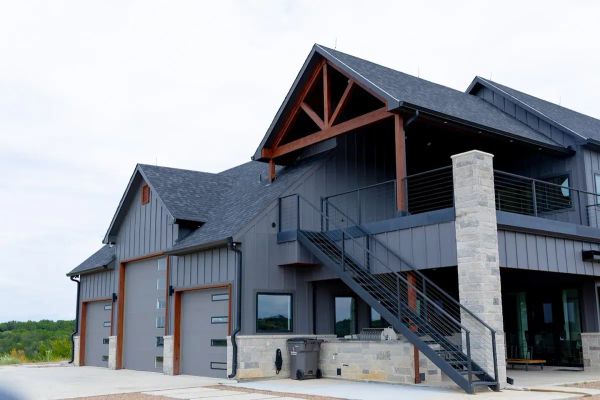
I have been building custom homes across Wise County for a good chunk of my thirty years in this business, and the questions I get about Decatur land follow the same pattern every time. A family finds acreage they love, puts it under contract, and then calls me asking what they should have checked before they signed. This is the list I actually give people, built from real jobs we have run out here, not a generic land-buying checklist.
What Should Decatur and Wise County Land Buyers Know?
Three things decide more than anything else on a Wise County tract: which government actually permits your build, whether the soil under your feet will support a basement, and what, if anything, is already recorded against the deed. Get those three answered before you close, and the rest of the project, the well, the septic, the driveway, runs the way it should. Skip them, and you find out the hard way, mid-design, that the plan you fell in love with does not fit the land you bought. We build custom homes on acreage across this county specifically because we have already made these mistakes once, decades ago, and learned not to repeat them.
Why Does the Wise County Line Change Your Build?
Because the office that permits your home changes the moment you cross it. Land around Weatherford and Springtown permits through Parker County. Cross the line toward Decatur, or over to Bridgeport, and you are now dealing with Wise County's offices for your septic permit, address assignment, and any flood development review. The rules are similar in spirit, no general countywide building code on unincorporated acreage, but the staff, the forms, and the turnaround times are not the same people. We have filed with both offices for years and keep current relationships on both sides, which matters more than people expect when a permit is sitting on someone's desk and your crew is ready to move.
This also matters if your tract straddles the border region. I have had clients shop land that looked like one county on a map app and turned out to be another once the title work came back. Confirm the county, not the zip code, before you assume which rules apply. If you have not closed yet, my land-buying checklist covers the title and survey items that matter regardless of which side of the line you end up on, and the site-infrastructure playbook I wrote for acreage around Springtown applies step for step once you are across it too.
Can You Count on a Basement in Wise County?
More often than in Parker County, but it is still a lot-by-lot question, not a given. I learned to build basements in Colorado long before I started doing it in Texas, and the first thing I will tell any Wise County client is that this county's soil is genuinely mixed. Some tracts sit on forgiving sand and gravel that take a basement well. Others have the same stubborn expansive clay we fight across Parker County, and a few have enough rock to change the whole excavation plan. You cannot tell which one you have by looking at the surface.
What we do instead: order a soils report before design starts, not after. It tells us bearing capacity, expansive clay content, and groundwater depth, and that report decides whether a basement is a straightforward yes, a yes with extra waterproofing and engineering, or a no for that specific pad location. I cover the engineering side of this in more depth in my post on basement foundation engineering for expansive clay, and it is the same logic we apply through our real Texas basements work, just with a different soil profile waiting under the grass.
Is There Really No HOA Out Here?
Often, yes, and it is one of the real draws of this market. A lot of Wise County acreage is working ranch and ag land with no HOA, no architectural committee, and no rule against the shop, the barn, or the livestock that brought you out here in the first place. But "often" is not "always." Some platted neighborhoods near town carry deed restrictions on exterior materials, minimum square footage, or outbuildings, and we read the actual recorded restrictions before design, every time, rather than trusting what a listing agent says in passing.
The other thing buyers miss: a lot of this land carries an agricultural valuation, which keeps the property tax bill low based on productive use rather than market value. Build a house on it and change that use, and you can trigger a rollback tax covering prior years at the higher rate, plus interest. The Texas Comptroller's guide to agricultural appraisal lays out exactly how that calculation works and which transfers are exempt from it. It will not stop you from building, but it belongs in your closing-day math, not a surprise on next year's tax statement.
What About Land Near the LBJ National Grassland?
It is one of the best reasons to build out here, and it comes with its own homework. The grassland sits as a patchwork of public units woven between private ranches north of town, which means fence lines, easements, and access roads around those boundaries deserve more attention than a typical rural tract. The National Forests and Grasslands in Texas, which oversees LBJ National Grassland, can tell you whether a boundary or easement question touches federal land, and your survey should flag it before you ever design a driveway. We have sited several homes along that edge, and the families who enjoy it most treated access and boundaries as a day-one question, the same way buyers near Azle have to think through lake-adjacent easements on their own tracts.
How Should You Budget Land and the Build Together?
The honest way: as one number, not two separate ones. Here is how the three common Wise County land situations actually differ.
| In-town Decatur lot | Unincorporated acreage | Grassland-adjacent acreage | |
|---|---|---|---|
| Who permits it | City of Decatur | Wise County | Wise County, plus federal boundary checks near grassland units |
| Typical utilities | City water and sewer | Private well and septic | Private well and septic, access road matters more |
| HOA or deed restrictions | Sometimes, check the plat | Usually none, but verify | Usually none, but check easements and fence agreements |
| Basement odds | Depends on the lot's soils report | Depends on the lot's soils report | Depends on the lot's soils report, plus access for excavation equipment |
| Typical project range on our builds | $1.2M to $4M-plus | $1.2M to $4M-plus | $1.2M to $4M-plus, often on the larger end |
Across all three, our real range as a company runs $250 to $550-plus per finished square foot, and most Decatur-area projects land in the upper half of that band because of the acreage scope and site work. Plan on 12 to 14 months to build once we break ground, plus another 3 to 6 months for design and permitting ahead of that. If you already own your lot and just want the house designed and built on it, that is exactly what our build-on-your-lot process is for.
What Should You Do Next?
- If you are still shopping for land, call before you close, not after. I will walk the tract with you, flag the soils, survey, and permitting questions that actually matter, and give you a straight answer, not a sales pitch. Reach me directly at (817) 736-6323.
- If you already own your acreage, start with the soils report and the deed. Those two documents decide more about your design than any Pinterest board will, and we can order both as the first step of your process.
- Walk our past work before you commit to a style. Our gallery shows what these builds actually look like finished, on land not that different from what you are considering.
Wise County still has the kind of land that is getting hard to find closer to Fort Worth, open sky, real acreage, and neighbors you cannot see from your porch. The families who end up happiest out here are the ones who treated the land itself as part of the design, not an afterthought to it. That is the only way I know how to build.