
I get this question almost every time a client is deciding whether to spend the money on a basement, and I always give the same honest answer: a basement is not a line-item investment that pays itself back dollar for dollar, in DFW or anywhere else. What it does is add real living space at the lowest cost per square foot in the house, and in North Texas basement construction specifically, it adds a feature that almost nothing else on the market has. After 30 years building here and in Colorado, I have watched that combination matter more to resale than any single percentage I could quote you.
Do Basements Add Resale Value in DFW?
Yes, but not in the way most people picture when they ask the question. Nationally, finished basement remodels have historically recouped somewhere in the range of two-thirds to a little over three-quarters of their cost at resale, depending on the year, the market, and how the project was scoped. That number moves around a lot and almost never applies cleanly to North Texas, because those studies are built from markets where basements are standard and comps are everywhere. In DFW, basements are rare enough that the normal math breaks down. You are not competing against a hundred other basement listings for buyer attention, you are often the only one on the street.
How Do Appraisers Actually Treat a Finished Basement?
This is the part almost nobody explains clearly, so here it is straight. Under Fannie Mae's appraisal guidelines, any level that is even partly below grade is excluded from the above-grade gross living area, the main number buyers and agents fixate on. Instead, the appraiser reports your basement on a separate line of the sales comparison grid and adjusts for it based on local market evidence. In practice, that usually means finished below-grade space gets valued somewhere between half and three-quarters of what the same square footage would bring above grade, based on what appraisers in your market are seeing in actual closed sales.
That sounds like a downside, and in a market with lots of basement comps, it can be. But in DFW it cuts a different way. Because so few homes here have a real basement, appraisers have thinner data to work from, which means a well-documented, professionally built basement with permits, engineering records, and clean comps from other custom basement builds tends to get a fairer shake than a DIY conversion with no paper trail. This is one more reason I keep every soils report, engineering drawing, and permit on file for every basement we build.
What Does the National Data Actually Say?
Here is the honest range. National real estate research, like Redfin's reporting on finished basement value, has tracked resale recoup historically landing somewhere in the mid-60s to high-70s percent of project cost, with real swings by region and finish level. I compare that against how I actually see it play out on a new-construction basement in Parker County below.
| Factor | National finished-basement remodel data | A real Texas basement built with the home |
|---|---|---|
| Typical resale recoup | Roughly 65-80% of project cost, varying by year and region | No reliable published percentage exists for DFW specifically, since basements are too rare here for a clean data set |
| What is being measured | Converting an existing, already-excavated basement shell into living space | Excavating, engineering, and waterproofing a basement from scratch as part of new construction, on expansive clay |
| Cost per finished square foot | Varies widely by region and finish level | $150 to $350 per finished square foot on our projects, driven by excavation depth, soils, and finish level |
| Biggest value driver | Matching the finish quality of the rest of the home | Rarity in the local market, storm protection, and genuine livable square footage at the lowest cost per foot in the house |
The comparison matters because most of the national data describes a different project than what we build. A homeowner in Ohio finishing out an unfinished basement shell is buying drywall, flooring, and a bathroom. A family building with us is buying excavation, structural engineering for expansive clay, and exterior waterproofing designed for a 30-year service life, the same work I detailed in my post on how much a basement actually costs in North Texas. That is a different cost basis, and it is also a different resale story.
Why Does Rarity Matter More Than the Percentage?
Because resale value is not just a formula, it is also who shows up to buy the house. Go look at active listings anywhere from Weatherford to Aledo to Granbury and count how many have a real finished basement. You will not run out of fingers to count them on. When a home with one hits the market, it draws a specific kind of buyer: families relocating from Colorado, Kansas, Oklahoma, or the Midwest who grew up with basements and actively filter their search for one, buyers who want a true below-grade storm refuge during North Texas severe weather season, and buyers who simply want more square footage without a bigger footprint on their lot.
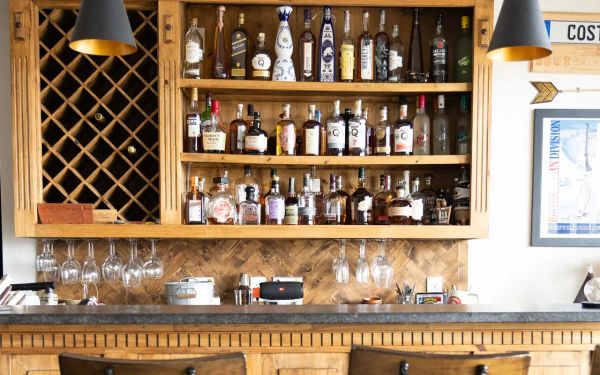
I will not promise you a specific percentage back at closing, because no honest builder can. What I can tell you is that a finished basement changes which buyers walk through your door and how they talk about the house once they are inside. A theater, wine cellar, or guest suite below grade photographs differently than the same square footage would as a bonus room over the garage, and in a market this short on basements, that difference shows up in how a listing performs, even if it never shows up as a line on an appraisal report.
Does the Type of Basement Finish Change the Resale Math?
Somewhat, and this is where I tell clients to build for their own life first. A basement finished as flexible living space, a game room, a family room, a guest suite with a full bath, tends to appeal to the widest pool of future buyers, the same way it would above grade. A highly specialized build, a dedicated wine cellar or a full home theater with built-in seating, can be a selling point for the right buyer and a non-factor for everyone else. Neither choice is wrong. I covered the full menu of what actually works down there, room by room, in my post on what you can put in a Texas basement.
What does not change, regardless of finish, is the hard part of the budget. Excavation, structural engineering for Parker County's clay soil, and exterior waterproofing happen once, during construction, no matter what you eventually put in the space. That is the expensive 70 percent of the project. The finish-out is comparatively cheap and fully reversible if your family's needs change down the road, which is a flexibility you do not get with the structure itself.
What Should You Do Next?
If resale is part of why you are considering a basement, here is the straight advice I give every client who asks:
- Do not build it purely as an investment. Build the space your family will actually use for the next decade, and let the resale benefit follow from genuine livability and rarity, not the other way around.
- Keep the paperwork. Soils reports, engineering drawings, permits, and waterproofing specs make your basement easier to appraise fairly and easier to market honestly when the time comes.
- Talk to a builder who will give you a straight answer, not a brochure number. I will walk your lot, tell you what a basement there would actually cost, and be honest about what it will and will not do for resale. Start with a free consultation through our contact page or call me directly at (817) 736-6323.
A basement is one of the only parts of a custom home you genuinely cannot add later without tearing the house apart. If resale is even a small part of the conversation, it belongs in your very first planning meeting, not an afterthought once the foundation is poured.