
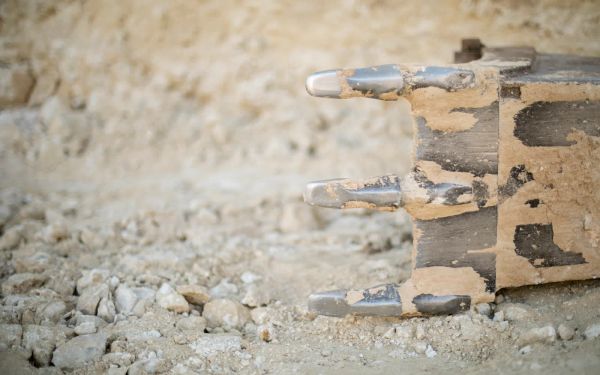
How deep can you dig in North Texas before you hit water? In most of Parker County, a standard basement excavation, roughly 9 to 10 feet, stays well above the permanent water table on the majority of lots I have built on. The complication isn't usually that deep water table at all. It's perched water, rain that gets trapped in a clay seam above it, which can show up at almost any depth after a wet spring. I cover the real mechanics and what we actually test for as part of our real Texas basements work, because guessing at this one before you dig is how a basement budget gets blown.
What's Actually Under a North Texas Building Site?
Most of Parker County sits on Cretaceous-age clay and marl, with harder limestone and sandstone layers mixed in depending on exactly where you are. That clay is the same material that gives us our famous expansive soil problems, and it also happens to be a poor conductor of water, which is part of why the true, permanent water table around here often sits deeper than people expect. The catch is that clay doesn't drain evenly. Water moving down through the soil profile can get trapped on top of a denser clay layer or inside a thin sand seam, forming what geologists call perched water. That perched water is temporary and seasonal, but it is also exactly what a crew runs into mid-dig after three days of spring rain, regardless of where the real water table sits.
The rock underneath shifts as you move across our market too. Lots closer to Weatherford and Aledo tend to sit on thicker clay sections, while ground out toward Possum Kingdom and the Brazos breaks runs into more sandstone and harder caliche layers closer to the surface. Harder rock near the surface actually works in a basement's favor in one way, since it sheds water differently than clay and often sits above the depth we need for a standard basement dig. But it also means excavation equipment and time can vary lot to lot, which is one more reason a countywide rule of thumb doesn't hold up on a specific parcel.
How Deep Is the Water Table, Really?
There is no single answer for Parker County, which is the honest truth most articles on this topic skip. I have worked sites west of Weatherford where borings came back dry past 15 feet, and I have worked sites closer to a creek bottom or low drainage area where we hit damp clay or seep water at 6 or 7 feet. The depth depends on your specific lot's elevation relative to local drainage, the rock layer underneath you, and how much rain fell in the weeks before we drilled. That range is also why I never quote a basement depth off a conversation alone. We pull existing well records through the Texas Water Development Board's groundwater database as a first look, then order a site-specific geotechnical boring before any structural engineer touches the design.
Permanent Water Table vs. Perched Water: What's the Difference?
| Permanent (true) water table | Perched water | |
|---|---|---|
| What it is | The actual top of the saturated groundwater zone | Rainwater trapped above a dense clay layer or sand lens |
| How deep | Often 10 to 30+ feet in much of Parker County, lot-dependent | Can appear at 2 to 10 feet, especially after heavy rain |
| How long it lasts | Year round, relatively stable | Seasonal, can disappear within weeks of dry weather |
| What it affects | Basement depth limits, pier bearing in some soils | Excavation scheduling, drainage design, waterproofing detail |
| How we test for it | Geotechnical borings, well logs | Geotechnical borings timed with seasonal moisture, visual inspection during excavation |
How Does This Actually Affect a Basement Build?
A basement 9 to 10 feet deep almost never requires fighting a permanent water table in the parts of Parker County where I build most often, places like Weatherford, Aledo, and the acreage out toward Brock. What it does require is a waterproofing and drainage plan built for perched water every single time, because I have never built a basement in this region where I would bet against at least some seasonal moisture reaching the exterior wall. That means a continuous below-grade waterproofing membrane, a properly sloped drain tile system at the footing, and a sump system sized for the soil, not a generic spec pulled off a shelf. This is the same discipline I learned building basements in Colorado decades ago, where crews treat water as a certainty, not a maybe, and I have carried that habit into every basement we've built here since.
The sump pump itself is not an afterthought either. We size the pump and the pit to the worst-case perched water scenario the boring suggests, not the dry-season average, and we always run a battery backup, because the storm that fills a perched water seam is often the same storm that can knock out power for a few hours. A basement that stays dry through a normal year and floods during the one bad storm every decade has not actually solved the water problem, it has just delayed it.
What Happens If You Hit Water You Didn't Plan For?
The honest answer is it costs you time and money, and the amount depends on how far into the project you find out. Hit unexpected water during the geotechnical phase, before a floor plan is even finalized, and it costs you almost nothing. You adjust the design, maybe shift basement depth by a foot or two, maybe add a more robust drainage system, and move on. Hit it mid-excavation because nobody tested first, and now you're paying for pumps, delays, and possibly a redesign while a crew sits idle. I have seen other builders' projects stall for exactly this reason, and it is always traceable back to skipping the boring to save a few thousand dollars on the front end of a $1.2M to $4M-plus build.
What Should You Do Before You Commit to a Basement Depth?
Order the geotechnical report before you fall in love with a floor plan. On acreage out near Springtown or Brock, where lots are larger and more variable, I treat this step as non-negotiable before we finalize basement depth, even if the seller or a neighbor insists they "know" the water table is deep everywhere out there. Ask your builder three direct questions: has a boring actually been pulled for this specific parcel, what did it show for both the permanent water table and any perched water signs, and does the waterproofing plan account for the wetter scenario, not just the dry one. If a builder can't answer those with real data, they're guessing, and basements don't forgive guesses.
If you want the fuller picture on basements in this market, I've also written about how we waterproof basements against Parker County clay and the foundation engineering that keeps a basement square in expansive clay, both of which connect directly to this same water question. You can also see finished basement work in our project gallery and read more about how we sequence testing into our five-stage build process.
What Should You Do Next?
If a basement is part of your plan, don't let a builder skip straight from a conversation to a contract price without a geotechnical report in hand for your specific lot. I've built more than 100 custom homes since 1995, and the ones with the fewest surprises are always the ones where we tested the ground before we designed anything on top of it. Walk your lot with me and I'll tell you honestly what the soil and water table mean for your basement. Schedule a free consultation or call me directly at (817) 736-6323.