
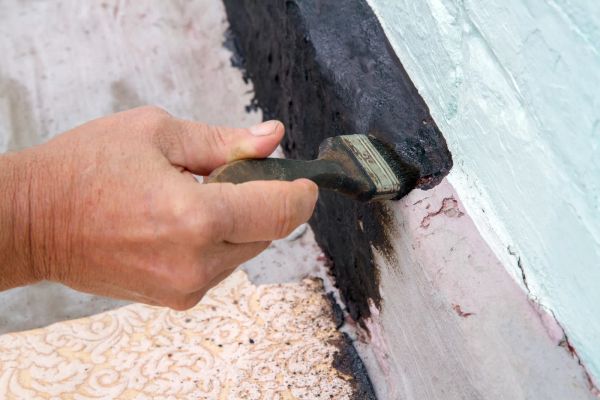
How do we waterproof basements in Parker County clay soil? With a true exterior membrane system, not a spray-on dampproofing coat, backed by a perimeter drain and select backfill, all of it inspected before the hole ever gets covered. I have built real Texas basements in this county for three decades, and every one of them comes down to that one sentence done correctly instead of done fast.
Most North Texas builders have never had to think this hard about a foundation wall, because almost nobody around here builds basements. I have had to think about it for thirty years, and the system I use today is the same discipline I learned waterproofing basements in Colorado, adapted for how Parker County clay actually behaves.
Why Does Parker County Clay Make Waterproofing Different From Other States?
Clay soil swells when it gets wet and shrinks hard when it dries out. In a normal Texas summer, that movement alone is enough to open hairline cracks in anything rigid that was not engineered for it, including a foundation wall. Add a water table that sits closer to the surface than most people expect across parts of this county, and you have two separate problems stacked on top of each other: a wall that wants to move, and water that wants to find any gap in it.
A dampproofing coat, the thin black asphalt emulsion most slab builders spray on a foundation, is designed to resist a little soil moisture. It is not designed to resist standing water pressing against a wall, and it is not designed to stretch with a wall that is moving underneath it. That is the gap between what most builders apply and what this soil actually demands.
What Is the Difference Between Dampproofing and Waterproofing?
People use these two words interchangeably, and that confusion costs homeowners real money in callbacks. They are not the same system, and only one of them belongs on a Texas basement wall.
| Dampproofing | True Waterproofing | |
|---|---|---|
| What it resists | Soil moisture and vapor | Standing water and hydrostatic pressure |
| Material | Sprayed asphalt emulsion | Liquid-applied or sheet rubberized membrane |
| Flexibility | Minimal, can crack with soil movement | Designed to bridge small cracks and movement |
| Typical use | Slab-on-grade foundations with no sustained water contact | Basements, retaining walls, below-grade rooms |
| Failure mode in our soil | Cracks, peels, or wears through within years | Holds up for decades when protected during backfill |
| Cost | Low | Higher upfront, far cheaper than a later excavation repair |
If a builder tells you dampproofing is good enough for a basement in this county, ask them to put that in writing with a warranty attached. Most will not, because they already know the answer.
What Waterproofing System Do We Actually Use?
Every basement we build gets the same core system, adjusted to what the soils report tells our engineer about that specific lot:
- Surface preparation. The concrete wall is cleaned, patched, and any form tie holes or honeycombing are repaired before anything gets applied. A membrane over a flawed surface fails at the flaw.
- A liquid-applied or sheet rubberized membrane, fully adhered to the wall and lapped at every seam, corner, and penetration. This is the actual waterproof barrier, not the dampproofing most builders reach for.
- A drainage board set directly over the membrane. This relieves hydrostatic pressure against the wall and physically protects the membrane from backfill material during the next step.
- Detailing at every penetration, including window wells, utility sleeves, and walkout door openings, since a perfect membrane with one unsealed penetration still leaks.
This is the same category of system used on basements across the Midwest and Mountain West, where builders have never had the option of skipping it. Parker County clay just makes the consequences of skipping it show up faster.
How Does Drainage Work With the Waterproofing Membrane?
A membrane alone is not a system. Water that reaches the wall and has nowhere to go will eventually find pressure enough to test every seam you have. So we build drainage as the other half of the equation:
A perimeter footing drain, a gravel-wrapped pipe, runs the full base of the foundation and collects groundwater before it can build pressure against the wall. That drain discharges by gravity where the site allows it, or into a sump system with a pump where it does not. On flatter Parker County lots, which is most of them, the sump is doing real work during a wet spring.
The backfill against that wall matters just as much as the membrane itself. We use select granular material, not the raw clay that came out of the hole, because clay backfill holds water against the wall and swells against it with every wet season. Backfilling a waterproofed wall with the same clay you excavated out of it defeats most of the purpose of waterproofing it in the first place.
What Mistakes Cause Texas Basements to Leak?
After thirty years and plenty of basements inspected during renovation work that other builders got wrong, the failures almost always trace back to the same handful of shortcuts:
- Dampproofing instead of waterproofing. The single most common mistake, and the hardest one to spot after the fact since it looks similar going on.
- No drainage board, so backfill material is placed directly against an unprotected membrane and tears it during compaction.
- Clay backfill against the wall, holding water in direct contact with the waterproofing and adding swelling pressure the engineer did not account for.
- Skipped or rushed penetration detailing at window wells and utility lines, which are the actual leak points in most failed basements, not the flat wall sections.
- No perimeter drain or sump, leaving the membrane to fight hydrostatic pressure alone with nowhere for the water to go.
Every one of those is a decision made to save a day or a few thousand dollars on a multimillion-dollar home. None of them are decisions I am willing to make, which is part of why we read the soils report from the USDA Web Soil Survey and our own geotechnical borings before we ever design the waterproofing detail for a lot.
How Do We Protect the Membrane During Backfill?
A waterproofing membrane that gets torn by a bulldozer bucket during backfill was never really there at all. We protect it three ways: the drainage board itself is a physical shield against sharp backfill material, backfill goes in lifts that are compacted gently near the wall rather than dumped and pushed, and we inspect the wall before each lift goes in, not just once at the end.
This step is also where the building code gets specific: the International Code Council's residential foundation provisions require damp-proofing at minimum and waterproofing in conditions with a high water table or hydrostatic pressure, which describes a meaningful share of Parker County lots. We treat that as the floor, not the goal.
This level of care is one reason basement work takes real time on the front end around Weatherford, Aledo, and Springtown, where we have poured the most basements. It is also why I wrote a separate piece on whether you can build a basement in Texas at all and another on what a Texas basement actually costs, since waterproofing done right is a real line item, not a rounding error.
What Should You Do Next?
If a basement is part of your plan, do three things before you sign with anyone:
- Ask to see the actual waterproofing detail in writing, not just the word "waterproofed" on a spec sheet. A real builder can show you the membrane product, the drainage board, and the drain layout.
- Ask how backfill is handled and inspected. This is the step most corners get cut on, because nobody sees it once the dirt is back in the hole.
- Call me and walk your lot. I will tell you honestly what your soil and water table mean for a basement, and what our basement storm shelter considerations look like for your family. Schedule a free consultation or reach me directly at (817) 736-6323.
You can see finished basement work in our gallery, and you can read how our five-stage build process handles this kind of detail from the first week of construction. Waterproofing is not a feature we advertise. It is the reason our basements from the 1990s are still dry, and it is the reason we are still building them thirty years later.