
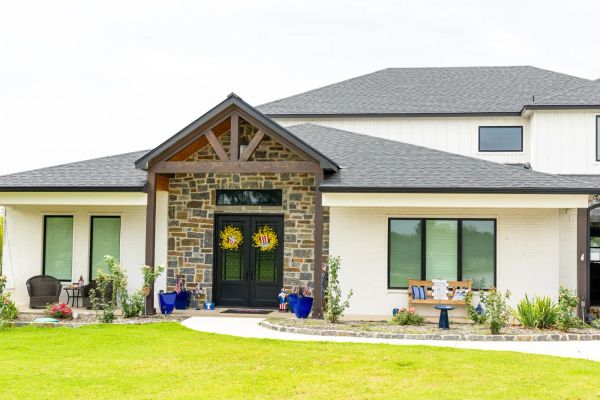
Clients bring me two kinds of photos almost every week: a steep-gabled white farmhouse with black windows, and a long, low stone home that looks like it grew out of the hill it sits on. Both are beautiful. Only one usually fits the land they actually bought. I walk every client through our project gallery early for exactly this reason, so they can see both styles built real, on real Parker County lots, before they fall in love with a plan that fights their site. Here is how I actually make this call on a job site.
What Actually Separates a Modern Farmhouse From a Texas Ranch?
A modern farmhouse is a vertical, front-facing style. Steep gable roofs, board and batten or vertical siding, black or dark bronze windows, and a prominent front porch, usually two stories or a story and a half, built to present well from the street. It descends from Midwestern farm architecture filtered through the last decade of design trends, and it photographs beautifully because it was designed to be looked at head on.
A Texas ranch is a horizontal, land-facing style. Low-pitched or gently pitched rooflines, deep overhangs, native stone, and a footprint that stretches out across one level instead of climbing up. The National Park Service's own writing on ranch house architecture traces the style to a deliberate break from vertical, formal houses toward informal, ground-hugging living, which is exactly what still makes it work on wide Texas acreage. A ranch home is not meant to be the subject of the photo. The land is.
Does Your Lot's Shape and Slope Favor One Style?
This is where I start every design conversation, before we talk finishes or square footage. A flat or gently rolling lot with road frontage, the kind we see a lot of in newer sections of Aledo, gives a farmhouse room to stand tall and present itself. A wide, open parcel with long view lines, common on acreage near Brock and out toward Possum Kingdom, almost always wants a ranch footprint instead, because a two-story vertical mass on open land can look stranded, like it was dropped there rather than built there.
Slope matters just as much. A sloped lot often wants a walkout level more than it wants a second story, which pulls the design back toward a ranch profile with a finished lower level rather than a tall farmhouse silhouette. I have walked enough lots now to know within the first ten minutes which way a site is pulling, and I would rather tell a client that before we draw a plan than after.
How Do Roofline and Materials Differ Between the Two?
| Element | Modern Farmhouse | Texas Ranch |
|---|---|---|
| Roofline | Steep gables, often 8:12 or steeper | Low to moderate pitch, 4:12 to 6:12, wide eaves |
| Footprint | Taller, narrower, often two stories | Long, low, usually single story or walkout |
| Primary material | Board and batten, vertical siding, black windows | Native stone, brick, timber accents |
| Best lot type | Flat to rolling lots, street-facing frontage | Wide acreage, sloped or view lots |
| Feels most at home | Newer subdivisions, infill sections | Open land, ranchland, lake property |
Neither column is a fixed rulebook. Most of our builds borrow from both: a standing seam metal roof and black window grids from the farmhouse side, paired with heavy native stone and a lower, wider footprint from the ranch side. That blend is honestly what most Parker County buyers end up asking for once they see it built, because it reads as current without abandoning what actually belongs out here.
Which Style Handles North Texas Sun, Wind, and Clay Soil Better?
Both styles can be built to perform well here, but they earn it differently. A ranch's deep overhangs and single-story mass naturally shade more wall and window area through a Texas summer, which keeps cooling loads down without relying on tricks. A farmhouse needs that shading designed in deliberately, usually with a wraparound or deep front porch and careful window placement, since its taller, narrower form has more exposed wall facing the sun.
Roofing performs about the same either way if you choose it right. We put standing seam metal on both styles because it sheds North Texas hail and heat well, and the reflective benefit is real: ENERGY STAR's own research on cool roofing shows reflective roof surfaces measurably cut cooling costs and roof surface temperature. What does not change by style is the foundation. Parker County clay soil moves, and we engineer the slab and footing the same way whether the house above it is a farmhouse or a ranch, because the ground does not care which magazine you pulled the elevation from.
Can You Blend Modern Farmhouse and Texas Ranch in One Home?
Yes, and I would argue most of our recent builds do exactly that rather than committing to either label. A low, long ranch footprint with a farmhouse's black windows and board and batten gable accents is one of the most requested combinations we build right now, and it tends to age better than either pure style, since it is not chasing a single trend. The same blending shows up in interior choices I wrote about in our design trends piece: warm wood beams, working pantries, and real indoor-outdoor living cross both exteriors without conflict.
If you want a sense of how this plays out at real budget numbers, my post on what a $1.5 million custom home looks like in Aledo walks through a build that leans farmhouse up front and opens into a much more ranch-influenced rear elevation facing the backyard. That is a pattern I steer a lot of clients toward: farmhouse where the street sees you, ranch where the land does.
Which Style Fits Acreage vs a Neighborhood Lot?
On a half-acre to one-acre neighborhood lot in town, especially around Weatherford, a farmhouse usually wins, because the lot is narrow enough that a taller, street-facing form makes sense and there is not enough land for a sprawling single-story footprint anyway. On five, ten, or fifty acres, a ranch almost always wins my recommendation, because the whole appeal of acreage is the land itself, and a low, long home lets you see more of it from inside instead of competing with it from outside.
This is also a practical build question, not just an aesthetic one. Every custom plan we draw starts in our home design and floor plan process with a real site walk, because the right exterior style falls out of the lot, the setbacks, the septic field location on acreage, and the view corridors, not from a Pinterest board brought in before anyone has seen the dirt.
What Should You Do Next?
- Walk your land before you commit to a style. Slope, road frontage, and view lines will tell you more than any elevation rendering can.
- Bring both kinds of photos to your first meeting. I would rather talk you out of a style that will fight your lot now than redesign after the foundation is engineered.
- Think in decades, not seasons. A style chosen to match the land holds up the way a style chosen to match a trend does not.
We have been building custom homes in Parker County since 1995, more than 100 of them, almost always a few at a time so I can be on every job site personally. If you are weighing farmhouse against ranch, or more likely some honest blend of both, schedule a free consultation or call me directly at (817) 736-6323 and I will walk your land with you before either of us commits to a plan.