
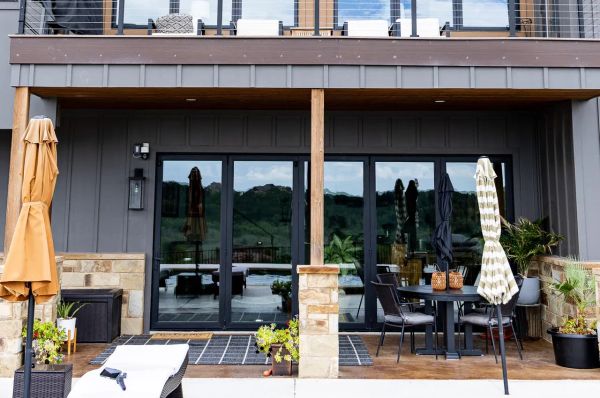
A walkout basement is the easiest basement I build, and it is almost always because the lot handed it to me. Most of what I do in North Texas basement construction involves fighting expansive clay and a stubborn water table on flat ground. A sloped lot flips that fight in your favor. If your land drops six feet or more from the front to the back, you are not just sitting on a basement site, you are sitting on the best kind of basement site there is.
Can You Build a Walkout Basement on a Sloped Texas Lot?
Yes. In fact, I would rather build a basement on a sloped lot than a flat one, because the grade does half the work for you. On flat ground, every basement wall is fully buried, and the only way out is an interior staircase plus a window well or a bulkhead door we build from scratch. On a sloped lot, the natural grade change lets the downhill side of the basement sit at or near ground level, so that wall can carry full-size windows and a real exterior door instead of a window well. You get daylight, ventilation, and a second exit, and none of it is a design trick. It is just the land doing what it already wants to do.
What Makes a Lot a Good Candidate for a Walkout Basement?
I look for at least six to eight feet of natural elevation change across the building pad, usually front to back or side to side. That is enough for the basement level to be fully buried on the uphill side, under the main house, while the downhill side opens straight out to grade. I have built this exact condition on lake lots near Possum Kingdom, on bluff lots around Granbury and Hood County, and on rougher acreage out toward Mineral Wells, where the land backs up to the Palo Pinto County hill country instead of flat prairie. If you are not sure whether your lot has enough fall, that is one of the first things I check on a site walk, often before we talk about floor plans at all.
Less slope than that does not rule out a basement, it just changes the design. A lot with three or four feet of change might only daylight one corner, which gives you a partial or "English" basement with big windows but not a full walk-out door. Either way, the soil work is the same conversation I cover in my post on how we waterproof basements in Parker County clay soil, because the buried walls on a walkout basement face the exact same clay the rest of your foundation does.
How Is a Walkout Basement Different From a Standard Basement?
The structure underneath is nearly identical. Footings, foundation walls, waterproofing, and a drainage system tied to daylight or a sump pump, all of that is the same whether the basement is fully buried or partially exposed. What changes is the exterior wall assembly on the downhill side, which gets framed and finished more like an above-grade wall, with real windows, exterior doors, and whatever siding or stone carries the rest of the house. That wall also needs proper flashing and drainage detailing where it transitions from buried foundation to exposed frame wall, which is a detail I have seen plenty of out-of-area builders get wrong on their first Texas basement.
| Feature | Standard buried basement | Walkout basement on a sloped lot |
|---|---|---|
| Natural light | Window wells only, limited | Full windows and glass doors on the exposed wall |
| Primary exit | Interior stairway, plus an egress window well | Interior stairway, plus a direct ground-level door |
| Excavation | Full depth burial on all sides | Full depth on the uphill side, minimal on the downhill side |
| Typical cost impact | Baseline | Often lower per finished square foot, fewer window wells and less deep uphill excavation |
| Best use cases | Theater, storm room, wine cellar | Game room, guest suite, or secondary living space that feels like a main floor |
What Does a Walkout Basement Cost in North Texas?
We generally see $150 to $350 per finished square foot on a basement, and a walkout often lands at the lower end of that range relative to the ceiling height you get, since you are not paying for the window wells, extra waterproofing detailing, and full-depth excavation a buried basement needs on every side. I go through the full cost breakdown, including excavation, structural engineering, and finish-out, in my post on how much a basement actually costs in North Texas. The site work itself, grading, retaining walls if the slope is steep enough to need them, and drainage routing, varies more lot to lot on a sloped site than it does on flat ground, which is why I always want to walk the land before I give a number.
Do You Still Need to Engineer for Expansive Clay on a Slope?
Yes, and if anything the engineering gets more attention, not less. A sloped lot usually means more variation in soil depth and composition across the pad than a flat lot does, and expansive clay reacts to moisture the same way whether it is buried under a basement wall or cut into a hillside. We pull soil data and order borings specific to the building pad, the same step I would take on flat ground, using resources like the USDA's Web Soil Survey as a starting point before site-specific testing. A slope also adds surface drainage to the conversation, since water moving across a hillside during a North Texas downpour needs somewhere to go that is not against your foundation wall. That grading and drainage design is part of the same foundation planning covered under the structural requirements in the International Residential Code's foundation chapter, which our engineers work from on every basement we build, sloped lot or not.
Can a Walkout Basement Double as Storm Protection?
It can, and in some ways it is a better storm space than a fully buried basement, not a worse one. The structural shelter value is the same, you are still below grade behind engineered walls. What changes is the exit situation. A fully buried basement depends on one interior stairway and a window well as backup. A walkout basement gives you that same interior stairway plus a direct ground-level door on the exposed wall, so if debris ever blocked one way out, you would have another. I wrote more about how basements compare to dedicated storm shelters in my post on basement versus storm shelter, which is worth a read if storm safety is part of why you are considering one.
What Should You Do Next?
If your land has any real elevation change, do not assume a basement is off the table just because you have not seen many in North Texas. More often than not, a sloped lot is the easiest basement site I get handed all year. Bring me the lot, even before you have settled on a floor plan, and I will walk it with you, tell you honestly whether it daylights enough for a full walkout or a partial one, and give you real numbers instead of a brochure range. You can see examples of finished basement spaces and the homes they sit under in our project gallery, or start with a free consultation through our contact page or by calling me directly at (817) 736-6323.
Thirty years in and after learning basements the hard way in Colorado, I will tell you straight: the lots everyone else drives past because they look too hilly to build on are often the ones I get most excited about.